
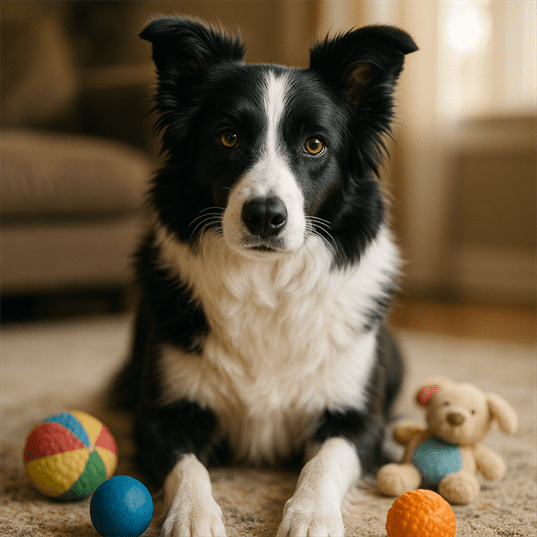
In the grand tapestry of animal intelligence, dogs stand apart—not just as loyal companions, but as problem-solvers, linguists, and emotional savants. While octopuses puzzle boxes and crows craft tools, dogs uniquely bridge species with humans, reading our cues like living empaths. But who claims the throne as history's smartest dog? It's a crown forged not in obedience trials alone, but in feats of vocabulary, inference, and creativity. Enter Chaser, a black-and-white Border Collie from South Carolina, USA, whose mind outshone all verified rivals. Trained by retired psychology professor John W. Pilley from puppyhood in 2004, Chaser amassed a lexicon of 1,022 distinct words—toys by name—earning her Guinness World Records' title for Largest Vocabulary by a Dog (verified 2010). She didn't just fetch "ball"; she discriminated among 1,000+ objects, inferred novel commands like "tug toy," and obeyed sentences with verbs, nouns, and prepositions. Chaser passed in July 2019 at 15, but her legacy reshapes how we view canine cognition.
Chaser's saga began humbly. Pilley, inspired by Rico—a German Shepherd in a 2003 Science study who learned 200 words via fast-mapping (inferring names from exclusion)—adopted Chaser at 8 weeks. Three-hour daily sessions ensued: Pilley hid toys, issued names, rewarded correct fetches. By 18 months, she knew 200; by three years, 800. Skeptics demanded proof. In 2010, Pilley and student Alliston Reid tested her blind: 838/1,022 correct (82% accuracy). Chaser aced categories—fetching "all Fido toys" from 100+ or excluding known items for new words. She grasped syntax: "Take 'ball' to 'Frisbee'" meant transport one toy using another as pointer. Videos show her pondering errors, self-correcting—a hallmark of reasoning. Pilley's 2013 book Chaser: Unlocking the Genius of the Dog Who Knows a Thousand Words details this, backed by peer-reviewed papers in Behavioural Processes (2011) affirming her exclusionary inference, akin to toddler language acquisition.
Chaser wasn't a lab anomaly; she herded virtually, alerting to strangers, and empathized—comforting Pilley during illness. Post-retirement, she starred in documentaries like 30 for 30: The Dog and TEDx talks, amassing fans. Her death from heart failure prompted global tributes; Pilley followed months later.
Yet, Chaser faces historical rivals. In the 1920s vaudeville era, "wonder dogs" dazzled crowds. Lady Marvel (trained by William Miller) reportedly understood 50 English words, 35 French, and 15 Italian, performing arithmetic via paw taps—though likely cuing tricks. Strongheart, Hollywood's first star (1921 films), solved puzzles publicly, but feats were scripted. Princeton's Fellow (1920s), owned by Dr. Edward Thorndike's circle, learned 200 nouns and verbs, discriminating shapes/colors—early behaviorism poster pup. Bashkim, a 1970s Yugoslavian mutt, allegedly tallied to 100, but unverified.
Modern challengers pale. Rico (German Shepherd; trainer Julia Fischer) fast-mapped 200+ words, retaining 70% after gaps—published in Science, sparking dog IQ boom. Sophia, a Belgian Malinois, knows 300+ military commands. Monty, a therapy Collie, navigates mazes and signals pain. Russia's Lev Vyatskin dog (a mutt) reportedly fetched by color/shape/number. Pony Hörlich, a Border Collie mix, "does math" by paw-counting treats (trained by Hungarian Lajos Széki), solving 4+5=9 visually.
In history's pantheon—beside Clever Hans (horse math illusion, debunked 1907)—Chaser shines authentic. She wasn't smartest by breed fiat, but relentless proof. Dogs, co-evolved 40,000 years with us, mirror our potential: boundless with nurture. As Pilley said, "Chaser shows every dog has genius within." In a dumbed-down scroll era, her thousand-word world urges: listen closer, teach deeper. The smartest dog? Not just history's—it redefined what's possible.