
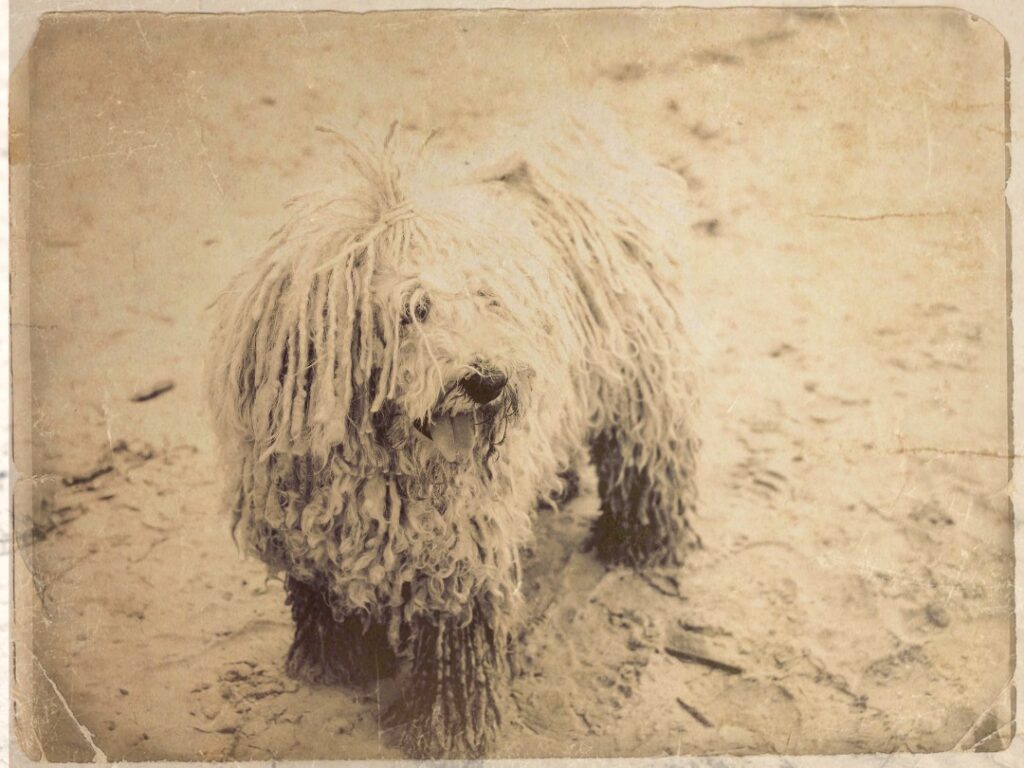
The Komondor, Hungary’s magnificent livestock guardian with its distinctive corded coat, faced one of the most devastating chapters in its 1,000-year history during World War II. As Hungary aligned itself with the Axis powers, this ancient breed found itself navigating a landscape of occupation, conflict, and near-total destruction.
The Perfect Storm for a Pastoral Breed
Before the war, approximately 100,000 Komondors roamed the Hungarian countryside, serving as steadfast protectors of sheep flocks across the puszta. The breed’s thick, corded coats—evolved to withstand harsh Carpathian winters and fend off wolves—made them ideal guardians of both livestock and property in rural communities.
When Germany occupied Hungary in March 1944, everything changed. The systematic deportation of Hungary’s Jewish population, combined with widespread military operations, created chaos across the countryside. Many Hungarian farmers, including those who owned and bred Komondors, were displaced, deported, or killed. Flocks were seized by military forces, and the pastoral lifestyle that had sustained the breed for centuries simply ceased to exist.
Dogs of Resistance and Rescue
Despite—or perhaps because of—their imposing presence, Komondors became unexpected participants in resistance activities. Several documented accounts describe these powerful dogs guarding the homes of Jewish families who faced deportation. Their intimidating appearance and fierce loyalty made them natural guardians.
One particularly notable story involves a Komondor named Csonti belonging to a Jewish family in Debrecen. When the family was rounded up for transport to concentration camps, Csontor escaped and was later discovered sleeping at the gates of a Budapest safehouse operated by Raoul Wallenberg. Whether the dog arrived by coincidence or some form of animal intuition remains debated, but the story has become part of Komondor folklore.
Resistance fighters also utilized Komondors as lookouts and guard dogs. Their keen senses and wariness of strangers made them excellent early warning systems against approaching patrols. Their massive size—males can weigh over 100 pounds—provided additional deterrence.
The Brutal Tally of War
The statistics tell a grim story. By war’s end in 1945, Hungary’s Komondor population had collapsed from an estimated 100,000 to fewer than a dozen confirmed purebred specimens. The combination of combat losses, intentional killings by occupying forces who viewed large dogs as threats, starvation during sieges, and the systematic destruction of the rural infrastructure that sustained the breed pushed the Komondor to the very edge of extinction.
Male dogs were particularly devastated, as they were often shot on sight by soldiers who viewed them as dangerous. Females, while somewhat safer, still faced enormous challenges reproducing in a world where their traditional role no longer existed.
The Remarkable Recovery
What followed the war stands as one of the most remarkable breed recovery efforts in canine history. In 1945, a Hungarian veterinarian named Dr. Ferenc Orosz recognized the urgent need to preserve the remaining Komondor gene pool. He launched an intensive search across the war-ravaged Hungarian countryside, seeking surviving specimens.
Dr. Orosz eventually located eleven dogs that he determined to be authentic Komondors, though some had interbred during the chaos of war. These eleven dogs became the foundation of the modern Komondor population. Carefully managed breeding programs, initially at the Hungarian Agricultural Museum and later through dedicated breeders, slowly rebuilt the breed over subsequent decades.
The recovery was painstakingly slow. The breed’s large size, extensive grooming requirements, and the specialized knowledge needed to properly maintain corded coats presented challenges for breeders. Additionally, Hungary’s communist government, which took power after the war, initially showed little interest in preserving capitalist-era livestock breeds.
A Symbol of Hungarian Resilience
The Komondor’s survival became intertwined with Hungarian national identity during the post-war period. The breed came to symbolize resilience in the face of overwhelming adversity—just as Hungary had survived foreign occupation and emerged from devastation, so too had its ancient shepherd dogs persisted against impossible odds.
The first Komondors exported to the United States arrived in 1962, thanks to the efforts of American breeders who recognized the breed’s unique qualities. The American Kennel Club officially recognized the Komondor in 1967, creating an additional refuge for the breed’s genetics outside Hungary.
Lessons from the Corded Guardian
Today, the Komondor population has recovered to approximately 10,000-12,000 dogs worldwide, with the majority still residing in Hungary. The breed’s wartime experience serves as a reminder of how profoundly historical events can impact animal populations, and how dedicated individuals can reverse even the most catastrophic declines.
For those who love the Komondor today, the story of the eleven surviving dogs represents hope—a testament to the idea that even when circumstances seem utterly hopeless, the spark of preservation can ensure that remarkable breeds survive to grace future generations with their ancient presence.
The Komondor that walks the parks of Budapest or guards sheep on the Hungarian puszta today carries within it the genetic legacy of those war survivors, a living reminder of a breed that nearly vanished but somehow, against all odds, endured.