
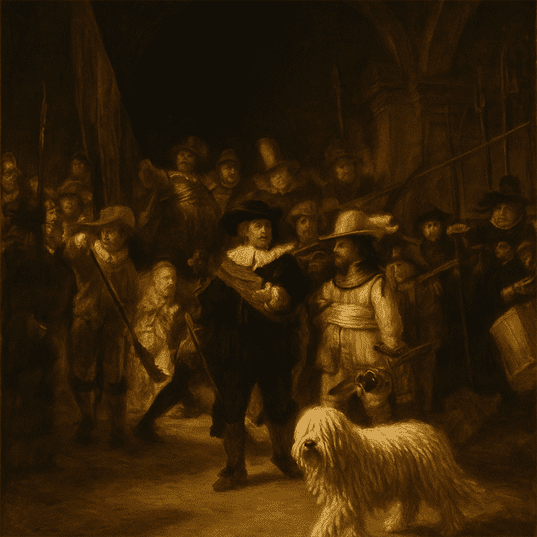
The Komondor: Europe's Corded Guardian – A 1,000-Year European Saga
The Komondor, with its unmistakable dreadlocked white coat resembling a shaggy mop, stands as one of Europe's most iconic livestock guardians. Native to Hungary, this massive breed (males often exceeding 100 pounds and 27 inches at the shoulder) has roamed the continent's vast plains and mountains for over a millennium, fiercely protecting sheep from wolves, bears, and human threats. Exclusively shaped by European history—from nomadic migrations to brutal invasions and modern preservation efforts—the Komondor's story is deeply intertwined with Hungary's pastoral heritage. Let's unravel its corded legacy.
Ancient Arrival: Magyar Roots in the Carpathian Basin (9th–12th Centuries)
The Komondor's European chapter begins around 895 AD, when the Magyar tribes, fleeing steppe pressures, conquered the Carpathian Basin to found Hungary. These nomadic horsemen brought with them shaggy, white herding dogs—ancestors of the Komondor—from the Ural Mountains and Eurasian steppes. Archaeological finds, like shepherd graves with canine remains, hint at their presence, though written records are scarce.
These early Komondorok (plural in Hungarian) were prized for their size, strength, and snow-white coats, which camouflaged them among sheep while repelling predators. Hungarian folklore credits them with superhuman feats: defending flocks solo against wolf packs. By the 11th century, under King Stephen I's Christian kingdom, they guarded royal estates and monastic herds in Transylvania and the Great Hungarian Plain (Pusztas). Their dreadlocked coat, formed naturally from coarse hair, provided armor against bites and thorns—perfect for Europe's rugged terrains.
Medieval Flourishing: Nobles, Monks, and the Puszta Life (13th–16th Centuries)
The 13th century brought reinforcement. In 1239, Cuman (Kun) tribes—Kipchak Turks fleeing the Mongols—settled in Hungary at King Béla IV's invitation. They introduced similar corded guardians, interbreeding with Magyar dogs to refine the breed's ferocity and independence. Now a staple of Hungarian shepherding, Komondors thrived on the puszta (open plains), living semi-feral with flocks year-round.
Medieval records from the 14th–15th centuries describe them in estate inventories: Transylvanian monasteries like those in Kolozsvár (Cluj) bred dozens for wool protection. Nobles, including the Hunyadi family, deployed them as estate watchdogs. A 1541 Turkish chronicle even notes "white devil dogs" terrorizing Ottoman scouts. Their role expanded beyond livestock—guarding villages from bandits during Hungary's feudal wars. Breeding remained folkloric, selected for traits like aloofness to strangers and unwavering loyalty to "their" humans and sheep.
Trials of Invasion: Survival Amid Ottoman and Habsburg Storms (16th–19th Centuries)
Hungary's "century of fire" (1500s–1700s) tested the Komondor. The Ottoman Empire occupied central Hungary from 1541, ravaging plains and decimating herds. Wolves proliferated in war-torn wilds, demanding the dogs' vigilance, but many shepherds fled, and the breed dwindled. Survivors hunkered in remote Tatra Mountains and Hortobágy National Park marshes, where isolated csikós (herdsmen) preserved pure lines.
Habsburg reconquest by 1699 brought stability but new pressures: Enclosures reduced roaming flocks, and fashion favored smaller dogs. By the 1800s, Komondors teetered on extinction, relegated to poorest shepherds. A pivotal 1815 painting by Arthur Meggyessy depicts one—the earliest visual proof—fueling romantic nationalism amid Hungary's 1848 revolution.
Revival and Standardization: The 19th–20th Century Renaissance
The 19th century's nemzetiség (national awakening) sparked revival. Veterinarian Dr. Tibor Mérei and breeder Sándor Dávid began systematic breeding in the 1880s, scouring puszta for specimens. The first Komondor appeared at the 1885 Budapest Dog Show, captivating audiences. The Hungarian Kennel Club formalized the standard in 1920, emphasizing the corded coat (fully formed by age 2), black mask, and guardian temperament.
Interwar Hungary celebrated the breed: Count István Széchenyi promoted them as national symbols. WWII saw Komondors in military roles—guarding POW camps and airfields—though bombs and requisitions halved numbers. Post-1945 Soviet era collectivized farms, but breeders like the Mérei family smuggled bloodlines. By 1947, the Fédération Cynologique Internationale (FCI) recognized them in Group 1 (Sheepdogs).
Post-War Legacy: Guardians of Hungarian Heritage Today
Cold War isolation honed purity; Hungary exported breeding stock sparingly within Europe (e.g., to Slovakia, Romania). The 1970s puszta tourism showcased working Komondors, boosting prestige. Today, ~5,000 registered in Hungary (per MKSZ), with pockets in Poland and Serbia from historical migrations. Climate change and wolf resurgence reaffirm their role—Hortobágy packs still patrol UNESCO plains.
Challenges persist: Hip dysplasia from intensive breeding, coat maintenance deterring urban owners. Yet, EU protections safeguard the breed as cultural heritage. Festivals like the annual Komondor Show in Bagac draw crowds, honoring Europe's oldest guardian.
The Komondor's European odyssey—from Magyar conquests to modern show rings—embodies resilience. Once nearly lost to empires, it endures as Hungary's living legend, cords swaying over timeless grasslands.