
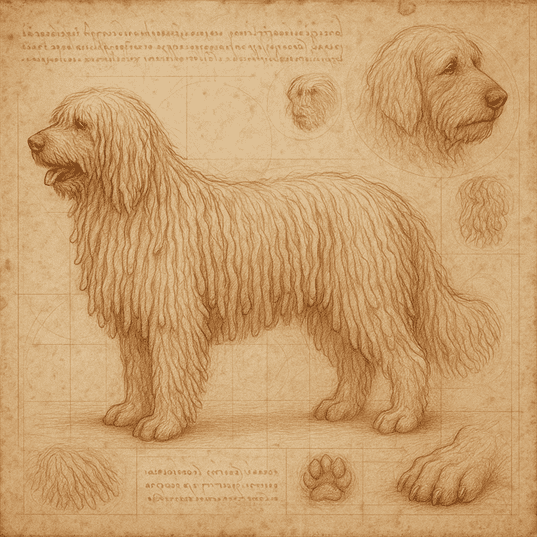
The Komondor, with its striking white, corded coat resembling a mop of dreadlocks, stands as one of the world’s most distinctive dog breeds. Originating from Hungary, this massive livestock guardian dog—often weighing over 175 pounds and standing nearly 30 inches at the shoulder or more—has protected flocks from predators for centuries. Its shaggy appearance isn’t mere aesthetics; the thick, felted fur shields against wolf bites and harsh weather, allowing it to blend seamlessly with sheep. But when did this enigmatic breed first appear in the annals of history? The earliest written record dates to 1541, offering a tantalizing snapshot of medieval Hungarian life.
Ancient Roots and Nomadic Legacy
While the Komondor’s precise origins remain shrouded in legend, historians trace its lineage to ancient pastoral dogs brought by nomadic tribes. The Magyars, who settled the Carpathian Basin around 895 AD, likely imported ancestors from the Tibetan Plateau via Turkish or Cuman routes. These proto-Komondor’s, akin to the Tibetan Mastiff, were prized for their ferocity and independence. Archaeological finds, such as dog bones from 10th-century Magyar graves, suggest large guardian breeds existed, but no written descriptions survive from this era. Genetic studies confirm the breed’s ancient divergence, linking it to other molosser-types used across Eurasia.
The breed’s name derives from Hungarian roots: “komor” (somber or shaggy) or Turkic “kuman” (Cuman people), with “dór” implying a guard dog. Its cords, forming naturally by age two, are a hallmark of adaptation to Hungary’s Puszta plains, where shepherds roamed with vast herds.
The Pivotal 1541 Document
The first explicit mention of “Komondor” emerges from Hungary’s turbulent 16th century, amid Ottoman incursions and feudal strife. In the Hungarian National Archives in Budapest lies an inventory from nobleman Mihály Perényi, lord of Szécsény Castle. Dated October 23, 1541, the list catalogs his estate’s assets post a military campaign. Among livestock and armaments, Perényi records: “3 good heavy Komondor dogs” (“3 jó nehéz komondor eb” in original Hungarian).
This terse entry is revolutionary. The term “nehéz” (heavy) underscores the dog’s imposing size, distinguishing it from smaller herding breeds like the Puli. Valued alongside horses and cattle, these Komondor’s were elite guardians, likely patrolling Perényi’s vast sheep flocks against wolves, bears, and bandits. The document’s context—Perényi, a Transylvanian voivode allied with Habsburgs against Suleiman the Magnificent—highlights the breed’s role in wartime logistics. Shepherds, integral to feudal economies, relied on Komondor’s for nocturnal vigilance, their white coats camouflaging them amid snow-dusted herds.
Why 1541? Hungary’s fragmented records from earlier centuries, ravaged by Mongol invasions (1241) and civil wars, left gaps. Chronicles like the 13th-century Gesta Hungarorum praise shepherd dogs generically, but none name the Komondor. Perényi’s list, preserved amid legal disputes over inheritance, provides the smoking gun—proof of the breed’s established presence by the Renaissance.
Echoes Through History and Modern Revival
Subsequent mentions abound: a 1673 poem by Count Miklós Zrínyi extols Komondor’s as “lion-like sentinels,” and 18th-century breeders formalized standards. The 19th century saw exports to Europe, but World War losses nearly extinguished the breed. Post-1945, Hungarian cynologists like Dr. Károlyi Thury revived it, with the FCI recognizing it in 1947.
Today, Komondor’s thrive as family protectors and farm dogs, their numbers around 10,000 worldwide. The 1541 record not only anchors their history but symbolizes resilience—much like the dog itself, enduring invasions and obscurity.
In an age of fleeting trends, the Komondor’s debut in Perényi’s ledger reminds us: true guardians leave lasting pawprints.